- Warm-up and concentrations activities from Artis:
Activity 1: Body Points (KS2) – A fantastic warm-up activity for body & spatial awareness, it also has a Maths focus and can be adapted for all year groups.
The First part of this activity where the participants are working individually will be adaptable for remote teaching.
Activity 2: Magic Sparkles– For Early years and Foundation Stage, this can be adapted to remote learning and use with many different topics – do not be afraid to progress this to standing. Use Music to enhance engagement.
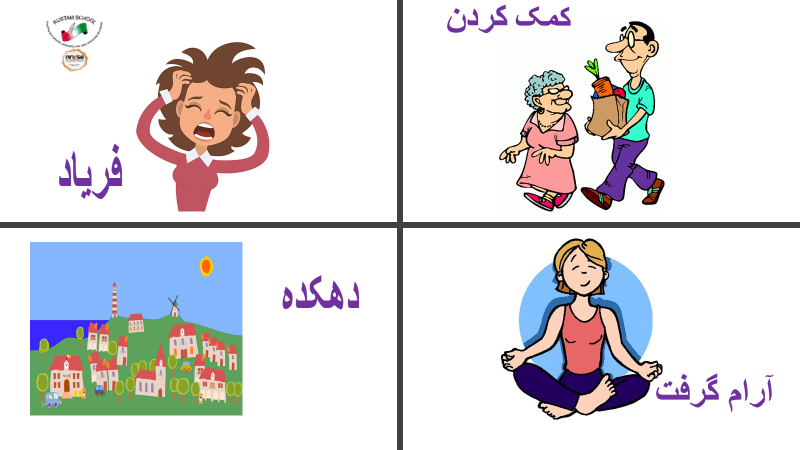
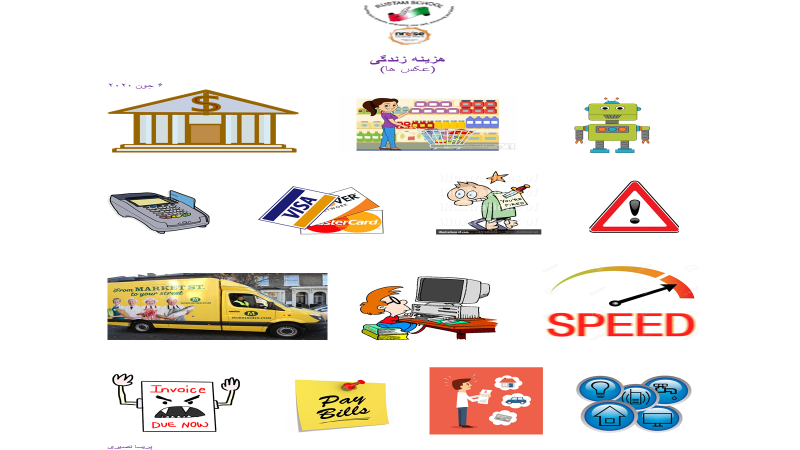
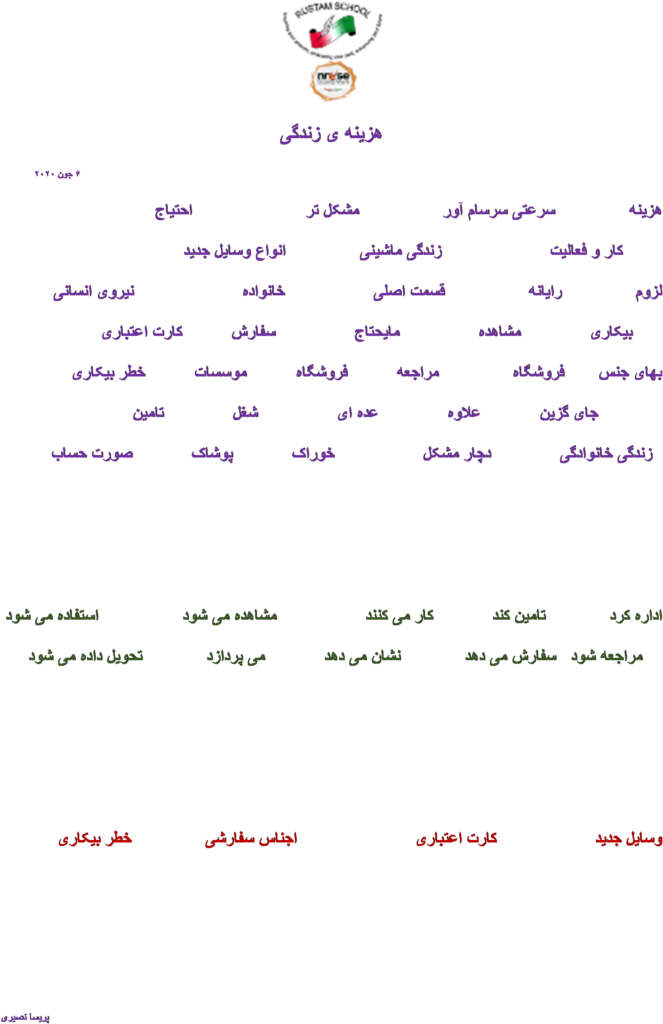
Parisa Nasiri From Rustam School talked about the use of a visual methodology, particularly the connection between the use of images and the introduction of new words when teaching the Farsi language. She explained her lesson plan ‘I put a picture on the screen and ask them what comes to mind. For example, they give me 4-5 words and say which word I’m looking for. They use it to make a sentence and then we write a paragraph with the words. They learn new vocabulary this way. For example, if the word has 5 letters then I put 5 dashes. They should only give me letters then and I put the right letters in the dashes. Together, we find the word – they really like the picture then guessing the specific words. I ask them if the word is related to a particular picture. They say how it relates to the picture – they find this activity fun. I encourage them to make a story using the words, just a few lines. I also use colour coding for words, different colours for nouns, adjectives and verbs. I’m trying to make it fun for them’.
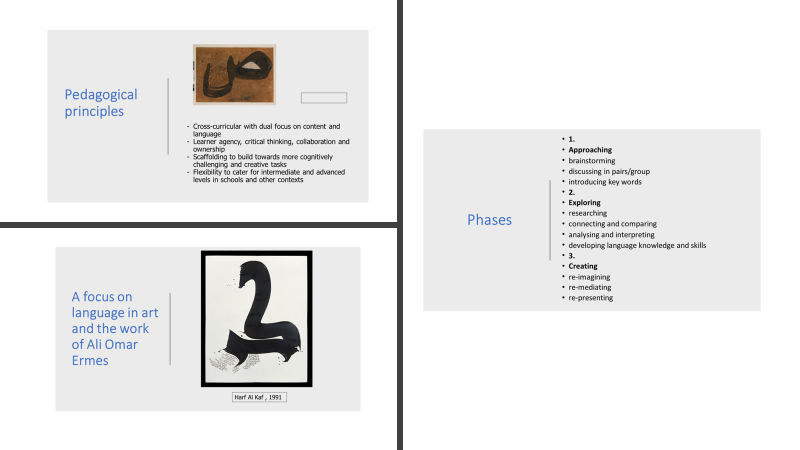
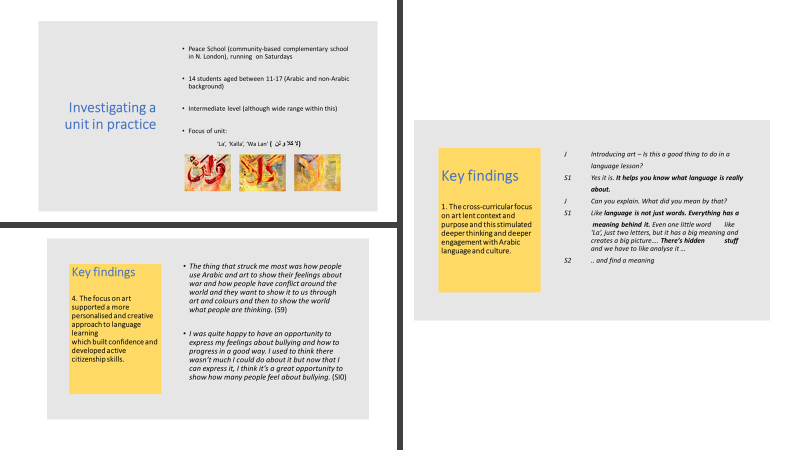
Fatima Khaled from Peace School presented the project ‘Teaching Arabic though Art and digital storytelling’. She explained that ‘this project links teaching and learning approaches to Digital Storytelling, which is creating a story to go digital. Then they create a film out of the story to show to different schools. We had to choose a theme for the stories in this project and chose the work of Ali Omar Ermes. His work is in the British Museum.
We approached the art from the outside. we approached it first by introducing key words. Second phase was exploring and then we connected the language and art, then we interpreted to combine the language together. Then we can ask the child to reimagine the art and link it to their own life. Reimagine and reinterpret.
We use these words, ‘No’, ‘never’ and ‘nevermore’ which is about opposing injustice. The students noticed red, black, orange, and yellow to express different ideas around anger. People use Arabic and art to express their feelings. When we asked for another subject, they chose the subject of bullying and made a film about it. They felt they could express ideas and feelings better about bullying that wasn’t possible before’.
Useful resources
In terms of some of practical teaching with the creativity of a film from my students in my complementary school “ Peace School” follow this link https://mdstmr.files.wordpress.com/2018/10/peace-school-20181.pdf
Main classroom resource
‘Language in Art and the Work of Ali Omar Ermes’ (2018) by Reem Abdelhadi, Luma Hameed, Fatima Khaled and Jim Anderson (Goldsmiths, University of London)
Teacher Professional Development support
- Video in 11 sections with guidance notes
- Arabic workshop PPT
- Planning Toolkit (Arabic and English versions)
- Poetry in the Arabic language classroom
- Report on unit from the resource in practice at the Peace School
- https://mdstmr.wordpress.com/arabic/aprofdev/
If you would like a general view of different resources from different schools and languages, please follow;
https://goldsmithsmdst.wordpress.com/peace-school/
I hope you will find something you will share with the language community.
I want to add that some of these resources are for Arabic language but the links can benifit non Arabic teachers as well, as the resources are made to help all languages teachers as well as Arabic teachers. I hope you will find them useful and can implement them in your teaching .
Best wishes
Fatima Khaled, Headteacher PEACE School

Leave a Reply
You must be logged in to post a comment.